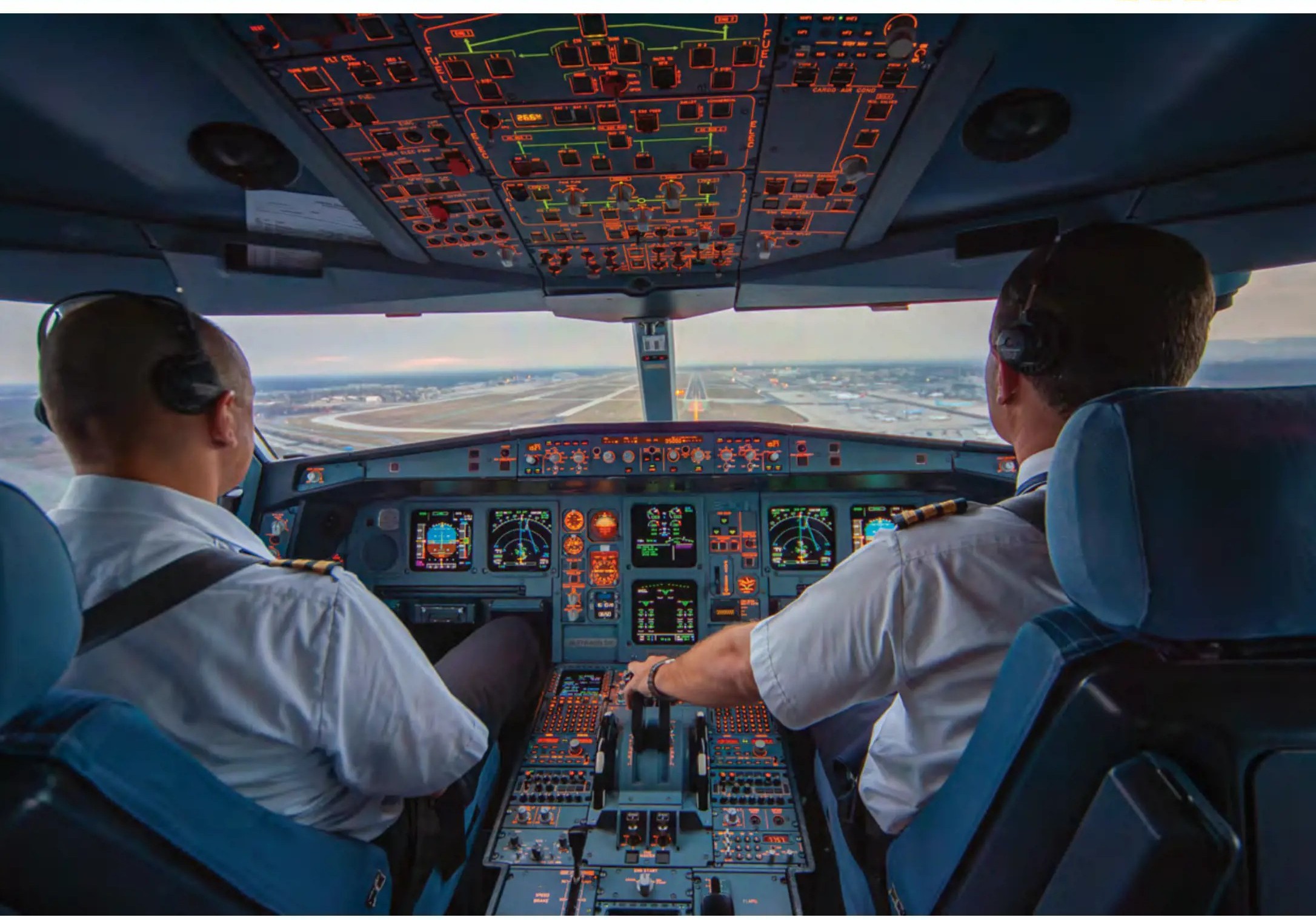
Becoming a pilot is a rewarding but demanding journey. From choosing between modular and integrated training to navigating costs and sitting theory exams, every stage presents challenges and choices. Commercial pilot in training Josh Eyre explains the key steps for aspiring aviators.
For many, and particularly those reading Airliner World, their ultimate dream is to become a pilot. If you decide you want to turn your dream into a reality and be one of 70,000 people across the world annually who train to become a pilot, what do you actually need to do?
The first step for many will be deciding whether to fly recreationally or whether they’d like to pursue it as a career. Of course, it is possible to start flying for fun before it ends up developing into something more serious. However, for argument’s sake, let’s say you’ve decided you’d like to be a ‘career pilot’. Exact routes and requirements vary considerably based on your location in the world, but for the United Kingdom and Europe, there are generally two main training routes to choose from: modular or integrated. Both have positives and negatives, and there is definitely no ‘one size fits all’.
ABOVE: Annually, about 70,000 people across the world train to become a pilot.
The modular method
Modular training involves attaining each licence/certificate separately. This route generally takes around two to five years, depending on various factors. Students usually start by attaining their Private Pilot Licence (PPL), then progress on to build some experience through hour building, completing a night rating to allow them to fly at night, as well as attending the dreaded Airline Transport Pilot Licence (ATPL) theory ground school. The next stage is to attain a Commercial Pilot Licence (CPL), Multi-Engine Piston (MEP) Rating and Instrument Rating (IR). Exact requirements and the order of training can vary.
The main advantage of the modular route is flexibility and cost. It allows students to fit flying more easily around work, studies and everyday life, as well as spreading the cost over time. The total cost of training is also typically more affordable. Many modular flight schools are “pay as you go”, meaning students do not have to stump up the full fees immediately. This route also allows students to shop around and combine training from a range of providers.
This flexibility could also be perceived as a disadvantage. Flight training is hard, but it gets even harder if gaps in continuity are introduced into the programme. As such, the modular route is considered by some to be riskier.
Integrated insights
The alternative is integrated pilot training, which is a full-time, structured flight programme that takes a student from little or no flying experience to a commercial, airline-ready pilot in a continuous course. It combines ground school, flight training, instrument flying, multi-engine training and ATPL theory in one organised and connected pathway. The programme is intensive and usually completed in about 18–24 months, making it the fastest route to becoming an airline pilot.
The clear advantages presented by the integrated courses are the speed at which training can be completed, as well as having the majority of your focus on learning to fly. The clearest disadvantage is that this route is more costly and significantly less flexible than a modular scheme, which may suit some, but can present a significant barrier to others. Many integrated courses are partnered with, or have good relationships with, commercial airlines and some even have the opportunity for a conditional job offer before or during the course. Flight schools such as Leading Edge or Skyborne Airline Academy in the UK specifically market their partnerships with airlines, giving students access to potential job opportunities.
Choices, choices
Once your route has been chosen, the next step is to select a training provider or multiple providers. Some flight schools offer both modular and integrated courses, while others just one or the other.
There are lots of variables to consider and not everyone’s needs and requirements are the same.
One of the biggest variables and barriers is usually cost. Although fully and partially funded training is becoming more and more common, it is still rare and it's also extremely hard, but definitely not impossible to be selected for it. If you aren’t fortunate enough to receive funded training, it's time to dig into your money box.
Funding pilot training can sometimes be the hardest part and for many is the single biggest barrier to entry. As mentioned, modular training is generally considered cheaper, usually ranging from £50,000–£80,000 (around €60,000–€95,000); while integrated pilot training typically costs about £80,000–£130,000 (approx €95,000–€155,000). This does vary depending on the flight school, pace of training and a number of other variables. Nevertheless, any route to the flight deck is expensive and can leave many pilots draining their savings, borrowing from family, taking out loans or selling/remortgaging property to cover the associated costs.
Other factors to consider when selecting training providers are location (travel or accommodation costs may need to be factored in), as well as aircraft type, general training quality and student feedback. Another aspect to consider, especially in countries that experience challenging weather, is whether the training provider has a fair‑weather base. This can significantly accelerate the pace of training, as well as potentially lead to long‑term cost savings.
Ready or not?
Let's say you've selected your route, funded your training, navigated and completed the training and have received your frozen ATPL. Does that mean you can fly for an airline? Unfortunately not. There are generally two more steps to go before you would be considered airline‑ready.
Upset Prevention and Recovery Training (UPRT) – which became mandated in 2019 – is specialised pilot training that teaches how to recognise, avoid and recover from unusual aircraft attitudes and loss‑of‑control situations. It focuses on preventing dangerous conditions such as stalls, excessive bank angles and airspeed extremes, as well as practising proper recovery techniques if an upset occurs. The goal is to improve pilot awareness, decision‑making and aircraft handling to enhance overall flight safety.
For those wishing to operate multi‑crew aircraft, which is the vast majority of airliners, the completion of an Airline Pilot Standards Multi‑Crew Co‑operation (APS MCC) course is an essential requirement. This advanced training is designed to prepare pilots to operate effectively in a multi‑pilot cockpit. The course focuses on crew co‑ordination, communication, leadership and followership, workload management and standard operating procedures (SOPs). Pilots practise normal, abnormal and emergency scenarios in a multi‑crew simulator, learning how to make decisions together and manage threats and errors. APS MCC is often required or strongly preferred by airlines because it bridges the gap between single‑pilot training and real airline operations.
The end of the beginning
Following the completion of the APS MCC course, you have reached the point at which you can start searching for and applying for jobs. While many people view a pilot as operating something like an Airbus A320 for a major airline, it's important to remember that piloting jobs can take many forms and that it is worth considering all avenues. While passenger airlines make up a large portion of opportunities, jobs can also entail cargo flying, charter work, survey flying and flight instructing.
The pilot recruitment process is rigorous and highly competitive, designed to assess both technical competence and personal suitability. In addition to interviews and knowledge testing, candidates usually complete mental aptitude and psychometric assessments that measure concentration, problem‑solving, multitasking, memory and performance under pressure. Most airlines also include a simulator assessment, where candidates fly realistic scenarios such as abnormal procedures, weather challenges and crew co‑ordination to evaluate handling skills, decision‑making and communication. Group exercises, behavioural interviews and medical checks further assess professionalism, teamwork and safety awareness before any offer is made.
Type training
Following the successful completion of the assessment process and an offer from an airline, it is time to undertake what is known as a type rating. This is an intense course allowing pilots to operate a specific aircraft or family of aircraft, with the programme comprising theoretical and practical simulator‑based training, including standard operations as well as emergency and non‑standard situations. A type rating is extremely in‑depth and requires pilots to learn and understand their aircraft inside and out. Richard Crossland, a type rating instructor and examiner at a major UK airline, explained: “A typical type rating is intense, with the programme only having time to review systems once in detail. Trainee pilots are sponges soaking up knowledge of one system before moving rapidly onto the next.”
The next step after type rating completion is base training. This is arguably the most exciting part of the process for most pilots, as it is where you will practise real take‑offs and landings in the actual aircraft, after completing simulator training. It usually involves flying multiple circuits (take off, fly a short pattern, land, repeat) at an airport with an instructor or training captain. The aim is to learn how the aircraft really feels and to manage real‑world visual cues – things a simulator can't fully replicate. For airline pilots, base training is often the first time they fly a jet for real and is a required step before carrying passengers on normal line flights. According to Crossland: “Base training is simply the most memorable day for any pilot, I still remember the day and registration of my first jet aircraft.”
Flying the line
The final major step in your journey to the flight deck will be line training. This is the stage where you fly actual passenger flights under supervision before being released to operate independently. After your type rating and base training, you operate scheduled flights with a training captain, who coaches and assesses you in real airline conditions, dealing with passengers, weather, air traffic control, time pressure and normal company procedures. You gradually take on more responsibility as your skills and confidence build.
Once you complete line training and a final check, you are signed off as fully operational and can fly regular rostered flights as a line pilot. Crossland said: “Line training is about building blocks and polish. It is less intense than the type rating, with time to reflect and build on experiences from the day.”
Being cleared to fly on the line unsupervised as a First Officer (or sometimes Second Officer or Cadet) marks the culmination of many years of training, resilience and personal growth, and represents a major milestone in a pilot’s journey. Flight training is a structured yet rewarding pathway that blends classroom learning, advanced simulator sessions and real aircraft flying to build the technical knowledge, practical skills and professional mindset required for safe and confident operations.
My training journey
Like many people, my childhood dream was to become a pilot. I was always fascinated by aircraft and the physics that allowed them to fly. When I left secondary school, I knew exactly what I wanted to pursue, but, like many aspiring aviators, financial constraints became my main barrier to entry. As a result, I completed an apprenticeship in plumbing, heating and gas, and eventually became a director within our family business in the same industry. Although I enjoyed my career and the responsibilities that came with it, my passion for aviation never faded.
In 2025, I finally decided to change direction and pursue pilot training. I’m currently enrolled on a course which I began in last September. While it is technically a modular programme, it runs back‑to‑back in a format similar to an integrated course. I commenced my PPL training in Malta and was fortunate to pass my skills test in mid‑November, before returning to the UK to begin my ATPL ground school, which is progressing well so far.
That said, not everything has been smooth sailing – or, should I say, flying! Initially, I found the theoretical side of the training the most challenging, which resulted in having to resit some exams. Like most students, I would much rather be in the air than behind a desk, but this experience reinforced the importance of having a strong theoretical foundation. The knowledge gained on the ground directly supports your decision‑making, safety and confidence in the cockpit. While the setbacks were frustrating at the time, they have ultimately strengthened my determination and reinforced my commitment to becoming a competent, safe and professional pilot.
Most importantly, this journey has reminded me that it is never too late to pursue a lifelong ambition. If you are considering a change, have a goal that excites you and are willing to commit to the hard work it demands, then it is absolutely achievable. Taking that first step can be daunting, but it can also be life‑changing. If you believe in the goal and are prepared to put in the effort, do it – you may surprise yourself with what you are capable of achieving.
Along the way, pilots master subjects such as navigation, meteorology, aircraft systems and human performance, before progressing through type rating, base training and line training, where they gain invaluable experience operating in real‑world commercial environments under supervision. Each stage demands discipline, adaptability and determination, shaping not only capable aviators but strong decision‑makers and team players.
While the path to the flight deck can look different for everyone, there is no single ‘right’ route, only the one that aligns the individual’s ambitions, circumstances and passion for flight.