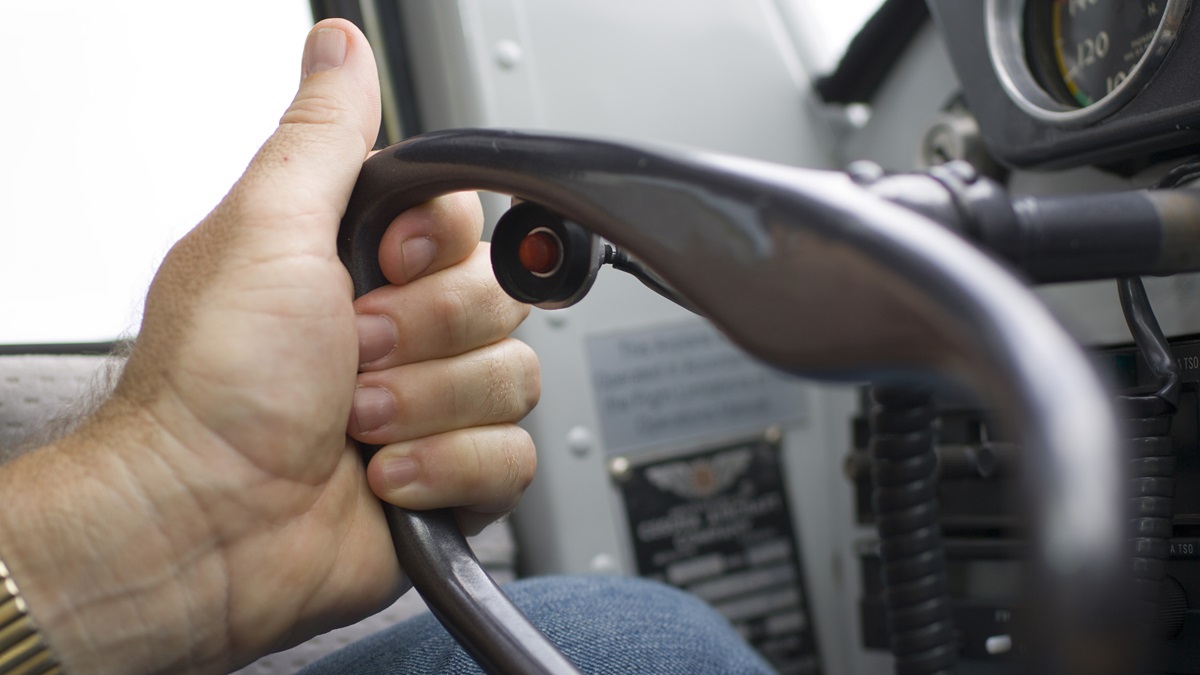
Up and down
We all learn very early what "up" and "down" mean. Driving a car is easy to understand: you turn the steering wheel right, and the car turns right. But pilots need to stop thinking in two dimensions.
On the ground, we steer an airplane with our feet, not with the "wheel". In the air, an airplane can change direction in all three dimensions, so the brain has more to learn.
When an airplane turns over
Most airplanes, from trainers to cargo haulers and airliners, fly more or less upright all the time. But sudden wind gusts, vortices from large aircraft and uncoordinated stalls can roll an airplane all the way to inverted. Then the pilot's mental model needs a big change. If inverted flight was not part of the plan, there is probably not enough time for this. But you can prepare for unusual attitudes: change the way you think about the flight controls.
Think about yourself, not the ground
Never think about your control inputs relative to the ground. Forget about pushing the yoke forward to lower the nose below the horizon, or pulling it back to raise the nose. If you think about "up" and "down" relative to the ground, you will get into trouble one day.
Think about yourself instead. In any position — in a turn, in a climb or descent, in a shallow or steep bank, or even upside down — these rules are always true:
If you pull the yoke toward you, the nose rises toward your head (or it feels like that).
If you push the yoke away from you, the nose drops, relative to you.
If you turn the yoke left, the left wing goes down, relative to you.
If you turn the yoke right, the right wing goes down, relative to you.
If you push the left rudder pedal, the nose moves to your left.
If you push the right rudder pedal, the nose moves to your right.
Think of the airplane as "rotating" around you. Then you will know which control inputs to use to put the airplane where you want it, when you want it there.
The slow roll
If you try aerobatic flight, with an experienced instructor in a properly equipped and certified aircraft, you will probably see this on your first day, in a slow roll.
A slow roll is a 360-degree roll around the propeller shaft on a steady heading. It looks simple, but it is one of the more difficult aerobatic maneuvers. For a good roll, with no wild wobbles of the nose, you need good rudder coordination. In a roll to the left:
Start with left stick and left rudder together. Keep the ailerons in the same place for the whole roll.
After 90 degrees, as the airplane comes near inverted, start to change the rudder. Upside down, you have left stick and right rudder.
Through knife-edge back to upright, go back to left stick and left rudder.
Ideally, your feet never stop: they make one careful, continuous movement from left to right and back to left.
If you understand the connection between the flight controls and yourself without thinking about it, this will help you when you recover from an upset, especially an unplanned one.