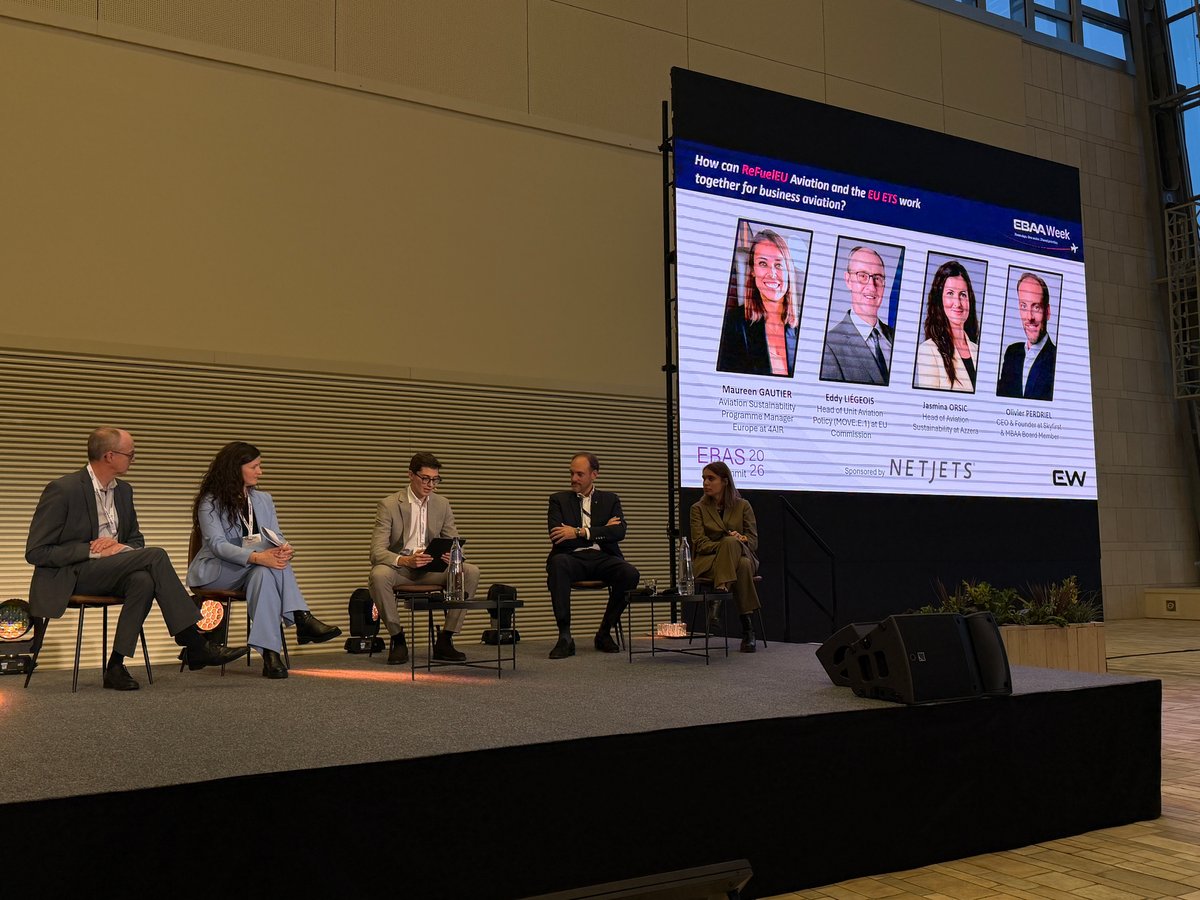
European business aviation leaders pushed back strongly against rising costs and restrictions. They say these threaten the future of their industry. At the European Business Aviation Summit in Brussels on Tuesday, they called on Eddy Liégeois, head of aviation policy at the European Commission (EC), to rethink the planned extension of the European Union Emissions Trading Scheme (EU-ETS). They also complained about how ReFuelEU’s anti-tankering rules are applied.
A wider EU-ETS, without SAF allowances
Under the plans, operators emitting at least 1,000 tonnes of CO2 a year, or perhaps even 250 tonnes, would have to report under EU-ETS. This would affect hundreds of smaller companies. Even more controversially, the EC wants to remove all allowances for using sustainable aviation fuel (SAF) from business aviation. Liégeois acknowledged that the aim is “to cover as many business aircraft operators as possible,” since their emissions per passenger are high compared with the airlines.
Olivier Perdriel, CEO of Malta-based charter operator Skyfirst, called the plan a punishment. In his view, it takes business aviation out of the system designed to encourage SAF use, and none of the money paid for EU-ETS and ReFuelEU compliance goes to sustainability. “We are OK with paying, but we need to know where the money is going,” he said.
According to sources close to the negotiations, the latest draft would restore the SAF allowances. Even if that is correct, the change may not reach the final rules. These must also be approved by the European Parliament.
Anti-tankering headaches
ReFuelEU’s anti-tankering rules aim to discourage operators from arriving at European airports with extra fuel. This fuel is bought at departure to avoid higher charges at the destination. For business aircraft operators, the problem is not only the cost: at some airports, refuelling during a short stop is impractical or even impossible.
Liégeois acknowledged that the rules may be reconsidered. In practice, he said, they had gone beyond their objectives, and officials had received thousands of requests for exemptions. While defending the core idea of ReFuelEU, he said the details would be reviewed in the second half of 2027.
Perdriel estimated that anti-tankering can add up to €30,000 a year on average to a small operator’s costs. This could lead to cost-cutting that affects safety. He also accused fuel companies of exploiting the rule at airports where they often have a monopoly, and said regulators need to check that too.
More operators, more paperwork
Perdriel said EU-ETS invoices arrive a year after the flight, which makes it hard to recover the money from clients. Some smaller operators may need a year to realize that the scheme applies to them. Billing can then take another year.
Maureen Gautier of 4Air expects the extension to bring at least 400 more operators into EU-ETS. Most will not have many aircraft or large teams. Still, they will have to contact their national authority, open an ETS registry account, track fuel by route and budget for their allowances. The EC also wants to apply EU-ETS to all flights into Europe from airports within 5,000 kilometers of Frankfurt. Gautier expects this to be even harder for foreign operators.
Jasmina Orsic of Azzera predicted that costs could double for typical operators brought into the scheme. If the real goal is to increase SAF use, she argued, operators who pay for SAF should be able to claim allowances under the ETS.
“A defining political battle”
Róman Kok, head of public and industry affairs at EBAA, described ETS reform as “a defining political battle” for business aviation. He urged the EC not to penalize early SAF adopters and called for equal treatment. Two operators with comparable flights, he said, should not face very different rules just because of how they are classified. “We are not opposing environmental ambition; we are opposing discrimination and unnecessary complexity.”
Kok also warned that at many European airports, limited capacity and increasingly restrictive conditions are making operations more difficult.